Visualizzazione post con etichetta techniques. Mostra tutti i post

martedì 19 febbraio 2013

VENEER MATCHING TECHNIQUES


Be glad, carpenters! Our rubric is back "on the blog"!

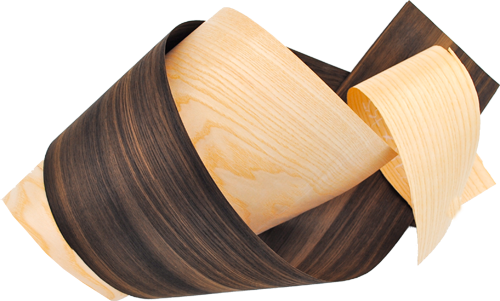
We must first resume what we have said on the previous episodes: we have written about how veneer can be cut and what is the process of veneering. But these sheets made out of wood can be smaller than your cupboard or table... So, they have to been matched. This matching process can be done with different methods, that can have different results.
Usually, sheets are sold in packs of 24/32 (it depends on the thickness and the type of wood). These packs are composed by veneer made out of the same part of the log, so they tend to have an homogeneous color.

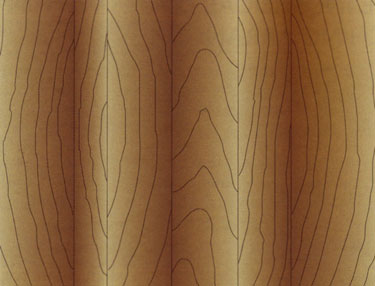
One of the most common approach is called book matching: alternative pieces of veneer are flipped over, so they match as pages of a book. This kind of matching technique is used on flamed wood (obtained by lengthwise cut). 


This is one of the most precious finishing, due to its perfectly symmetric  pattern and its homogeneous color.

Another approach is the slip matching

sheets are simply joined in sequence, without flipping them. Wood with straight grain are often put together like this, so the joins will not be obvious.
Another reason for using a slip matching concerns the color: if sheets are flipped, the painting can have a different results on the different sides.
Transparent and natural finishing are usually used.

Then, we can write something about the random matching:

this technique is just what it sounds like; sheets are chopped and then matched, without respecting any kind of grain or color. The results is a bigger sheet that has a pattern composed by different colors and grain.


There are some other approaches, that creates particular patterns and figures: diamond, reversed diamond, sun, box... Each of these can give to your furniture a refined look and a different meaning!


lunedì 4 febbraio 2013

Wood VENEERING


Here we go with the second technical articles, translated from this post. Today we are talking about the process off veneering, that is used to produce furniture that is resistant, nice and also less expensive that the one in massif wood. How does it can be possible?

First of all, you should have been read the article about wood SLICING, that will provide you a good explanation about the way we can obtain a sheet of wood.
Then, we must clear up the concept of veneering: this words refers only to the covering made by wood sheets (called veneer) and not to all kind of covering. Indeed, wood can be covered also by melaminic resins, but we'll talk about it another time.

Questions? Please feel free to pose questions on the comment area, under this post!
Now we can describe what happens to the sheet of wood. Once it is sliced from the log, it is dried up and sometimes also ironed, as your mother (or wife) does with your shirt, as there will be no unaesthetic pleats once you wear it.
These sheets undertake a docking and trimming, that means parallel and perpendicular cutting to make the edges uniform.


Now the veneer is ready to be joined one to another, to create bigger panels.
This laid-up veneer can be done in different ways, with glue on the edges or adding paper on the back of it. This last process is used to compose marquetry and it is also very useful when the veneer is applied on curved surfaces: in this way the wood is less likely to crack.
Anyhow, precision is essential. The pattern depends on the different lying up of sheets. Here you can see come examples.

These sheets are glued (with special kind of glue) on less-precious wood panels.


What about the result?
Stable and durable furniture, that resist better to woodworm attacks and are homogeneous when produced in series. Moreover, with an infinite choice of the patterns, that is limited only by our imagination (and technique progress). Some project can be realized only by using veneer, because the climate changes (hot and cold, rain and sun) cause a contraction and expansion of solid wood and this can compromise the stability of the furniture.


But, most important, wood veneering is ecological! Furniture made by wood veneer uses less wood that same pieces made by solid wood. Using wood requires 70% less energy than other materials.
Being eco-friendly means a greater possibility of recyclability and renewability, for a conscious and attentive use of wood resources.


At the end, some sort of curiosity: wood veneer was used since Renaissance. Obviously, they had no machinery like the ones we use today and, of course they sliced wood in thicker sheets.
This can be used to recognize the age of some furniture and avoid buying fakes!

mercoledì 30 gennaio 2013

Wood SLICING


Hi everybody!
As we have wrote in the first article of this year (you can find it here), we wanted to improve our international side, also by making available articles in English, for all our foreign online visitors.. So, here we go!
First of all, I'm going to translate the articles speaking about techniques.

Wood SLICER machine, is a device that, from an entire log, obtains sheets of wood, from 0.3 to 3 millimeters thick. If you think about that, it's a very precise and delicate processing, as the sheet can be thinner than your skin! (take a look at this scale of the universe, just to be aware of the dimension we are talking about). The name of this machine come from the fact that the piece of wood is literally sliced by a putting it on a lathe, with a fixed or moving blade. This sheet will be used, then, for the veneering process, that creates furniture at a lowest cost, but not always at a lowest quality, as we'll see soon.

Now we are going to describe some cuts and their result.

1) lengthwise cut (also said italian): the log is cut in the middle and the slicing is made parallel to the plane face. The result is a variegated figure, called flame or cathedral (you can easily see why!)


2) quarter slicing (or french slicing): in this case, the log is cut in 4 pieces and every piece is sliced parallel to the annual growth rings of the three (probably the image will explain much better then the worlds). The resultant sheet will have a straight grain appearance.


3) rotary cut: this is one of the two cases of slicing with a fixed blade. In the examples we have just spoken about, the wood was fixed, while here it rotates and comes nearer to the blade. if you can imagine it, it's like a spiral slicing. This kind of slicing is used for poor wood, that can be used afterwords for plywood and multi-ply.
4) half-round slicing: here is the second type of slicing with a fixed blade. As the rotary cut, the log rotates on itself, but it is not sliced all along its circumference, but on an arc parallel to the center of the log. 
This type of slicing is made on very precious essences and on small logs: in this way the wood don't get damaged and there are very few residuals.

Every type of cut gives the wood a very particular appearance; the sheets can the be combined as you like and create million of different patterns.
If you need some more information, don't hesitate to contact us!
I remember you that you can find us also on twitter and facebook! Our web sito is alwais available, both in English and in Italian language!